
Table of Contents
- Why Product Discovery and Repeat Sales Matter for Beauty Brands
- What Makes Beauty Ecommerce Different From Other Online Stores?
- How Shopify Improves Beauty Product Discovery
- Shopify Features That Encourage Repeat Purchases
- Comparison: Shopify Features for Product Discovery and Repeat Sales
- Real-World Examples of Beauty Brands Using Shopify
- SEO Strategies for Shopify Beauty Brands
- How to Build an Effective Shopify Beauty Ecommerce Strategy
- Key Metrics Beauty Brands Should Track
- Common Mistakes Shopify Beauty Brands Should Avoid
- Frequently Asked Questions
The beauty industry is becoming increasingly competitive, and customers have more options than ever when shopping for skincare, makeup, haircare, and personal care products. For ecommerce businesses, attracting visitors is only part of the challenge. Helping them discover suitable products and encouraging them to return are equally important.
This is where Shopify for beauty brands can make a meaningful difference.
Imagine a customer looking for a moisturizer. They may want a lightweight formula, a fragrance-free option, or a product containing specific ingredients. If the store makes it difficult to compare these choices, the customer may leave without purchasing.
Now consider a customer who has already purchased the same moisturizer twice. If the brand makes reordering convenient, shares helpful product guidance, and provides timely replenishment options, that customer may have another reason to return.
These two shopping journeys highlight an important opportunity for beauty ecommerce businesses: improving product discovery and building repeat purchase experiences.
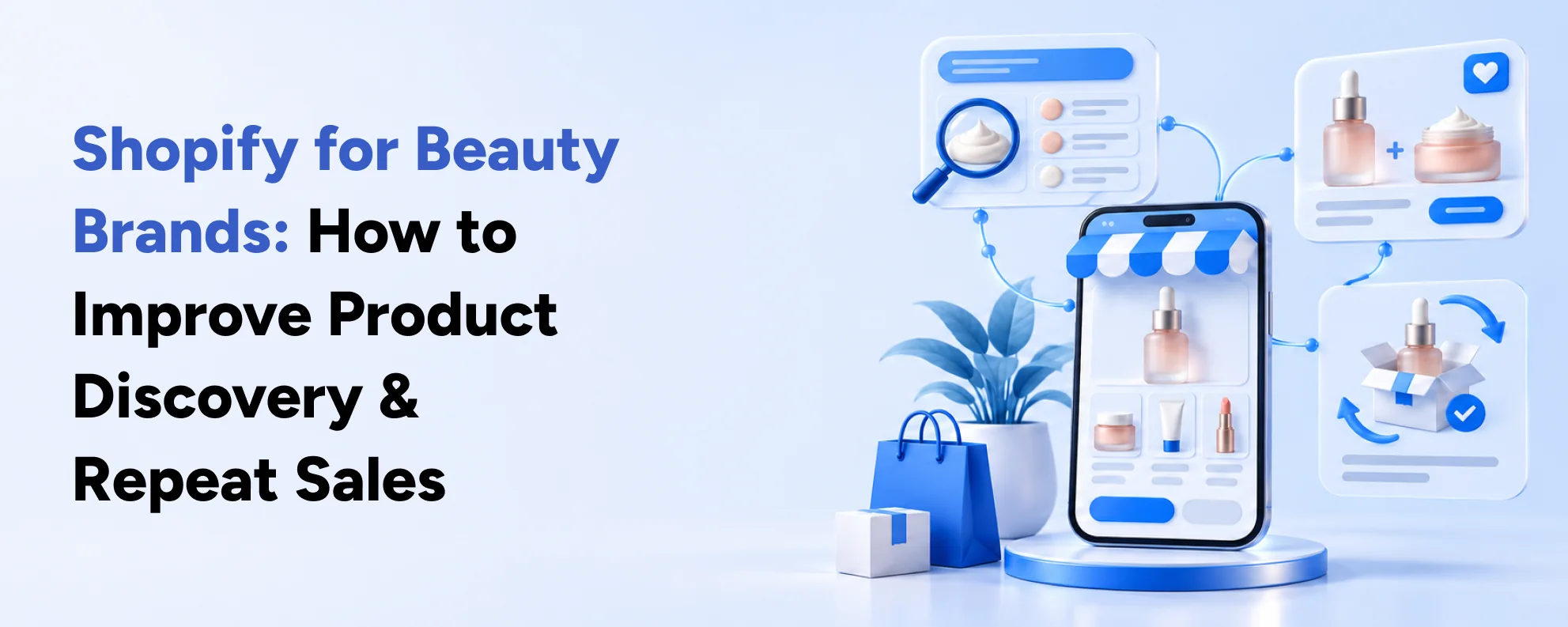
Shopify provides an ecommerce foundation for product search, customized collections, product recommendations, subscriptions, customer segmentation, and marketing automation. Combined with the right storefront design and retention strategy, these capabilities can help beauty retailers create a smoother journey from first discovery to future purchases.
This guide explores how beauty businesses can use Shopify to improve product discovery, simplify skincare and cosmetics shopping, increase customer confidence, and create more opportunities for long-term sales.
Why Product Discovery and Repeat Sales Matter for Beauty Brands
Product discovery and customer retention are two closely connected parts of a successful beauty ecommerce business.
Product discovery helps potential customers identify products that match their preferences and requirements.
Repeat sales occur when customers return to purchase the same products, explore complementary items, or discover new additions to the brand's catalog.
Unlike some products purchased only occasionally, many beauty and personal care products are used regularly.
For example, customers may repurchase cleansers, shampoos, moisturizers, deodorants, and other consumable products after finishing their previous supply.
This creates opportunities for beauty brands to maintain ongoing customer relationships.
However, repeat purchasing depends on more than product availability. Customers must feel confident about product quality, understand how to use the items, and find it convenient to buy again.
The Growing Opportunity in Global Beauty Ecommerce
According to McKinsey's June 2026 State of Beauty analysis, the global beauty market is projected to grow approximately 5% annually and reach $590 billion by 2030.
The report also estimates that ecommerce accounts for around 28% of global beauty sales across the channels included in its analysis.
These figures show the importance of digital commerce within the broader beauty industry.
However, growing online demand does not guarantee that every beauty retailer will succeed.
Customers increasingly discover products through social media, online creators, search engines, digital marketplaces, and recommendations.
As a result, beauty businesses must create shopping experiences that are informative, convenient, and trustworthy.
A Shopify store can support that objective, but its features must be configured around the needs of the brand's customers.
What Makes Beauty Ecommerce Different From Other Online Stores?
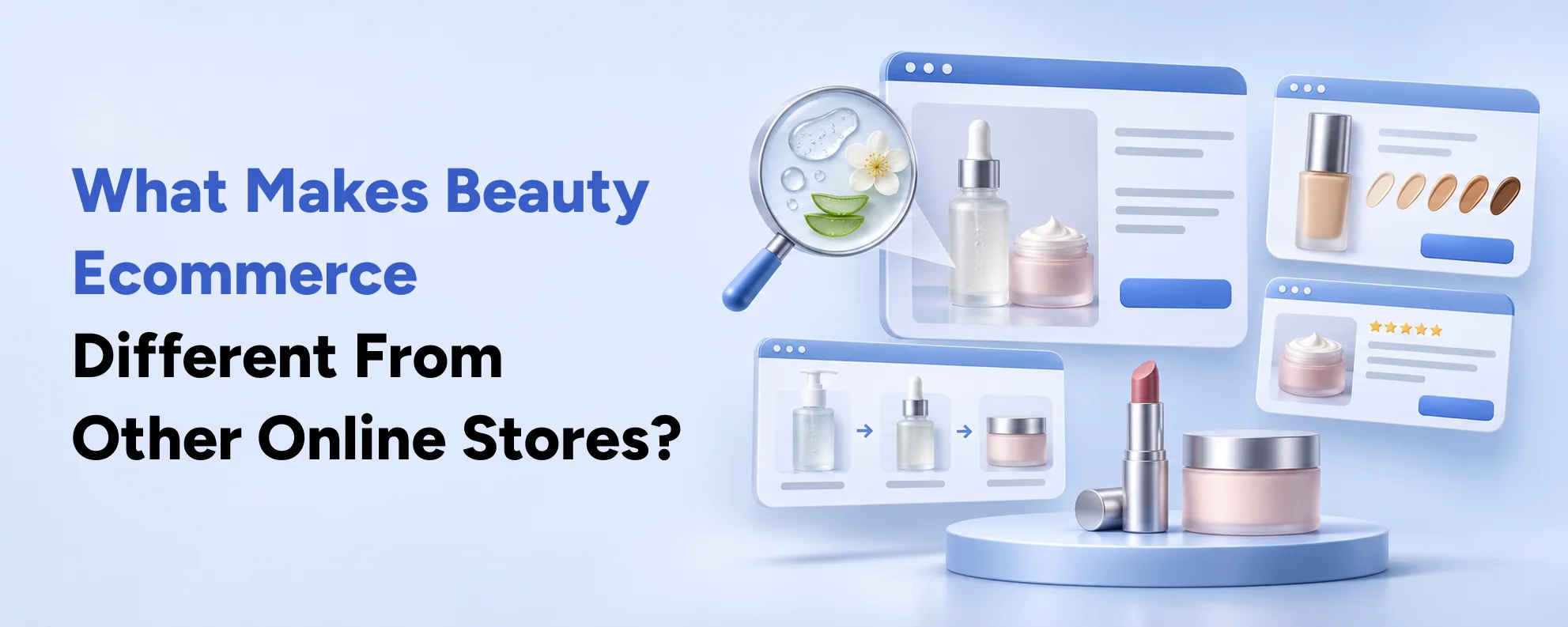
Beauty ecommerce presents several challenges that influence how customers discover and purchase products.
For clothing retailers, customers often focus on size, color, and fit. For electronics, shoppers may prioritize technical specifications.
Beauty shoppers frequently evaluate a different combination of attributes.
These include ingredients, product texture, shade, fragrance, skin preferences, hair characteristics, product usage, and compatibility with existing routines.
A customer searching for foundation may need help selecting a shade and understanding the finish.
Someone purchasing a shampoo may want to filter products according to hair texture, formulation, and personal preferences.
A skincare shopper may wish to compare ingredient lists before choosing a cleanser.
This means a beauty ecommerce website needs to do more than display products attractively.
It should help customers understand which products are relevant to their requirements.
Three Essential Parts of the Beauty Shopping Journey
1. Discovery
Customers need a convenient way to browse, search, filter, and compare products.
2. Confidence
Customers need accurate ingredients, product descriptions, usage instructions, reviews, and other trustworthy information before purchasing.
3. Retention
Customers benefit from convenient reordering, suitable subscription options, helpful post-purchase communication, and relevant recommendations.
When these three elements work together, an online beauty store can create a more complete customer experience.
How Shopify Improves Beauty Product Discovery
Product discovery is the process of helping shoppers find relevant products through navigation, search, product filters, recommendations, and educational content.
For beauty brands, effective discovery begins with understanding how customers describe their needs.
1. Organize Beauty Products Into Relevant Collections
A well-organized product catalog makes browsing more convenient.
Shopify allows merchants to create collections that group products according to different shopping requirements.
A beauty business might organize its store into major categories such as:
- Skincare.
- Makeup.
- Haircare.
- Body Care.
- Fragrance.
- Beauty Tools.
- Gift Sets.
- New Arrivals.
However, broad categories alone may not satisfy customers looking for more specific products.
For example, a skincare collection could include subcategories for cleansers, moisturizers, serums, and facial oils.
A makeup category could include foundations, concealers, lip products, blushes, and eye makeup.
Beauty brands can also create curated collections around routines or customer preferences, where these categories accurately reflect the products.
Organize Collections Around Customer Search Intent
Consider two customers visiting the same beauty store.
One searches for a particular serum.
Another wants to explore products for a simple daily skincare routine.
The first customer may prefer a search bar, while the second may benefit from a curated collection.
By supporting different shopping intentions, beauty retailers can reduce the effort required to find suitable products.
Example Collection Structure
A skincare store could organize its navigation as follows:
- Shop by Product: Cleansers, Toners, Serums, Moisturizers.
- Shop by Ingredient: Niacinamide, Hyaluronic Acid, Ceramides.
- Shop by Preference: Fragrance-Free, Lightweight Formulas, Rich Creams.
- Shop by Routine: Morning Essentials, Evening Essentials, Travel Essentials.
Collections should only contain products that genuinely meet their stated criteria.
This approach can make navigation more intuitive while supporting relevant ecommerce keywords.
2. Use Shopify Predictive Search to Help Customers Find Products
Many shoppers arrive at a beauty website knowing what they want.
They might search for:
- Vitamin C serum.
- Fragrance-free moisturizer.
- Matte lipstick.
- Shampoo for curly hair.
- Lightweight foundation.
- Hydrating face cleanser.
A basic search system that depends entirely on exact product titles may fail to deliver useful results.
Shopify's storefront search includes predictive search and typo tolerance.
These capabilities help customers discover products while entering search terms and accommodate certain spelling mistakes.
Shopify Search & Discovery also provides additional options for influencing product visibility and search results.
For beauty merchants, search relevance depends heavily on accurate product information.
A product labeled only as "Glow Formula 01" may be harder for customers to discover than a product whose title clearly identifies its type.
For example, "Hydrating Facial Serum With Hyaluronic Acid" communicates more useful information about the product.
However, product titles should remain accurate rather than becoming collections of repetitive keywords.
How to Improve Beauty Store Search
Review the terms customers use when searching your store.
Compare those queries with your product names, descriptions, and collection structure.
If customers regularly search for "lip oil" but the store uses only the term "lip treatment," consider whether the relevant products are sufficiently discoverable.
Search analytics can reveal product demand, confusing terminology, and potential gaps in your catalog.
A particularly useful metric is the percentage of searches that produce no relevant results.
Reducing unsuccessful searches can help shoppers reach products more efficiently.
3. Add Advanced Product Filters for Skin, Hair, Ingredients, and Preferences
Product filtering is especially valuable for beauty retailers with extensive catalogs.
Imagine a store offering more than 200 skincare products.
A customer wants a moisturizer without added fragrance, within a specific budget, and suitable for their preferred texture.
Without relevant filters, identifying appropriate products may require opening dozens of product pages.
Shopify Search & Discovery filters allow compatible storefronts to offer filtering based on product attributes and custom data.
The most useful filters differ by beauty category.
| Beauty Category | Useful Product Filters |
|---|---|
| Skincare | Product type, ingredients, texture, fragrance preference, price |
| Makeup | Shade, undertone, finish, coverage, product type |
| Haircare | Hair type, product purpose, formulation, size |
| Fragrance | Scent family, notes, concentration, size |
| Body Care | Product type, fragrance, texture, ingredient preferences |
| Beauty Tools | Product type, material, use, price |
Custom filters can be created using product metafields, category attributes, and other supported data structures.
For example, a skincare retailer could maintain consistent information about product texture across its catalog.
Customers could then filter between gel, lotion, and cream formulations.
Avoid Overcomplicating Filters
More filters do not automatically create a better shopping experience.
Customers should understand each filtering option without needing technical knowledge.
Use recognizable labels, avoid duplicating attributes, and display only relevant options within each category.
Also, Shopify's standard Search & Discovery filters have compatibility and catalog-size limitations, including the documented restriction affecting collections with more than 5,000 products.
Large beauty catalogs may require more focused collections or specialized search solutions.
4. Use Shade Finders and Visual Swatches for Makeup Products
Shade selection is one of the biggest challenges in online cosmetics shopping.
Foundation, concealer, lipstick, blush, and other color cosmetics often have multiple variations.
Customers need to understand how shades differ before choosing a product.
Shopify supports product options and variants, while compatible themes can display visual swatches.
A lipstick product might include variants such as:
- Rose Nude.
- Warm Coral.
- Berry Pink.
- Deep Plum.
- Classic Red.
Instead of displaying these options only as text, a brand can present visual swatches with accurate color references.
For foundations, customers may also benefit from information about undertones, shade depth, and product finish.
Specialized shade-matching quizzes or virtual try-on experiences can be implemented through compatible third-party technology or custom development.
These advanced features are not universal native Shopify capabilities.
Improve Shade Accuracy
Use consistent product photography and lighting.
Where appropriate, display shade swatches on different skin tones, and provide realistic descriptions of product color and finish.
Avoid suggesting that an automated recommendation guarantees a perfect match.
Beauty shoppers should have enough information to make their own informed selection.
5. Create Informative Beauty Product Pages Using Shopify Metafields
Beauty customers often read product information carefully before purchasing.
They may want to understand ingredient composition, usage instructions, quantity, packaging, and other characteristics.
Shopify's metafields functionality allows merchants to store additional product information beyond standard descriptions.
A beauty brand could use metafields for:
- Full ingredient lists.
- Product texture.
- Net quantity.
- Usage instructions.
- Fragrance information.
- Product benefits supported by evidence.
- Product warnings.
- Storage instructions.
- Relevant certifications.
- Packaging information.
For example, a product page for a facial cleanser could contain separate sections for Product Overview, Ingredients, How to Use, and Frequently Asked Questions.
This makes important details easier to locate.
Why Product Information Matters
Different customers evaluate beauty products differently.
Some prioritize ingredient transparency, while others focus on product performance, texture, value, or packaging.
A detailed product page allows shoppers to make comparisons without contacting support for basic information.
It can also strengthen product search relevance when descriptions use appropriate terminology naturally.
Product claims must remain accurate and appropriately substantiated.
For businesses selling in the United States, the FDA's cosmetics labeling guidance explains that certain disease-treatment or body-function claims may cause a product to be regulated as a drug rather than solely as a cosmetic.
International beauty brands should review the requirements of every market where their products are sold.
6. Introduce Personalized Beauty Product Quizzes
A product quiz can make shopping easier for customers who are uncertain about which product to choose.
Instead of browsing an entire skincare catalog, visitors can answer a few questions about their preferences.
For example, a beauty retailer might ask:
- What type of product are you looking for?
- Do you prefer lightweight or rich textures?
- Would you like a fragrance-free option?
- What is your preferred budget?
- Are you shopping for an individual product or a complete routine?
The answers can guide customers toward relevant products and collections.
Beauty quizzes can be implemented through third-party Shopify apps or custom integrations.
They are particularly useful when a brand sells many products that appear similar at first glance.
Keep Beauty Quizzes Helpful and Transparent
Questions should focus on relevant shopping preferences.
Avoid collecting unnecessary sensitive information or presenting a product quiz as a medical diagnosis.
Recommendations should explain why a particular item may match the customer's stated preferences.
When a quiz collects personal information for marketing, customers should understand how their data will be used and have appropriate consent choices.
A successful product quiz acts as a product discovery assistant rather than an aggressive sales form.
7. Use Authentic Product Reviews and Visual Content
Beauty shoppers often want to know how products perform in everyday use.
Product descriptions can explain features, but customer feedback provides additional perspectives.
A review may describe a moisturizer's texture, the appearance of a lipstick shade, or how easy a particular product is to incorporate into a routine.
Beauty brands can integrate compatible review applications to display verified customer feedback and product photographs.
Useful review information may include:
- Product ratings.
- Verified purchaser indicators.
- Customer photographs.
- Texture and application feedback.
- Product shade information.
- Customer usage experiences.
Video demonstrations can also be useful.
For example, a foundation demonstration may show the product's finish in different lighting conditions.
A haircare video could demonstrate how to apply a product and explain the amount typically recommended by its instructions.
Customer testimonials should be authentic. Do not invent reviews, fabricate results, or make product claims that cannot be supported.
Genuine product feedback can help shoppers develop more realistic expectations.
8. Recommend Complementary Beauty Products and Routines
Beauty products are frequently purchased as part of a routine.
A customer buying a facial cleanser might also be interested in a moisturizer.
Someone purchasing a shampoo might want to compare matching conditioners.
Shopify provides related and complementary product recommendation functionality through Search & Discovery and compatible themes.
These recommendations can help customers discover products that complement their original purchase.
For example, a skincare retailer might recommend:
- A moisturizer alongside a cleanser.
- A matching conditioner alongside shampoo.
- A lip liner alongside lipstick.
- A body lotion alongside body wash.
Recommendations should be based on meaningful product relationships rather than simply promoting expensive items.
Build a Complete Beauty Routine
A beauty brand can also create curated product bundles.
The Shopify Bundles app supports fixed bundles and multipacks.
For example, a daily skincare essentials bundle might contain a cleanser, moisturizer, and another suitable personal care product.
More complex build-your-own routines may require additional apps or custom development.
The goal should be to simplify shopping while providing enough information for customers to choose products that meet their preferences.
Shopify Features That Encourage Repeat Purchases
Product discovery helps customers find relevant items.
However, long-term ecommerce performance also depends on what happens after the first purchase.
Beauty businesses can use Shopify's commerce and marketing capabilities to create convenient repeat-purchase experiences.
9. Offer Replenishment Subscriptions for Frequently Used Products
Some beauty products are naturally suited to repeat purchasing.
Examples include:
- Shampoo.
- Conditioner.
- Facial cleanser.
- Moisturizer.
- Deodorant.
- Body wash.
- Other frequently replenished personal care products.
Customers who use these items regularly may appreciate a subscription option.
Shopify Subscriptions allows eligible merchants to offer recurring product purchases.
Depending on the configured subscription plan, customers can select delivery frequencies, receive subscription-related notifications, and manage their subscriptions through supported customer account features.
For example, a beauty retailer could offer a moisturizer as a one-time purchase or as a subscription with regular deliveries.
This gives customers a convenient choice.
What Makes a Beauty Subscription Attractive?
A subscription should offer clear value.
That value may come from convenience, consistent product availability, flexible delivery schedules, or an appropriate subscriber benefit.
Customers should understand the price, billing frequency, cancellation terms, and delivery conditions before subscribing.
Shopify subscription functionality includes supported options for modifying, skipping, pausing, and canceling subscriptions.
Availability and compatibility depend on the selected subscription solution, payment configuration, and merchant eligibility.
Avoid forcing subscriptions when customers would prefer a one-time purchase.
10. Make Reordering Favorite Products Easier
Not every customer wants a subscription.
Some may prefer purchasing products only when needed.
For these customers, convenient reordering can be just as important.
Shopify customer accounts and order history can help shoppers access previous purchases.
Depending on the storefront implementation, merchants can also introduce reorder actions or saved-product functionality.
For example, a customer who previously purchased a particular foundation shade should not have to repeat the entire product discovery process.
An effective reorder experience might help them return to the correct product and variant quickly.
This is especially useful for products with many shade or size options.
Reduce Friction for Returning Customers
Make important customer account functions easy to access.
Display accurate product availability and avoid directing customers toward discontinued variants without clear explanations.
If a product has changed formulation, packaging, or quantity, communicate those differences before the customer purchases again.
Convenient reordering supports retention by reducing unnecessary effort.
11. Send Timely Replenishment Reminders
Customers sometimes forget where they purchased a favorite product.
Others may plan to reorder but postpone the purchase until the product runs out.
Relevant replenishment reminders can bring customers back to the store.
Through Shopify Messaging and compatible marketing automation tools, beauty brands can communicate with eligible customers after purchasing.
Shopify Messaging, formerly Shopify Email, supports marketing campaigns and automations across available channels.
More specialized replenishment flows may require Shopify Flow, third-party integrations, or custom automation logic.
Example Replenishment Journey
Consider a customer who purchases a 200 ml shampoo.
A brand could use product usage estimates, actual repurchase data, and customer preferences to determine when a reminder might be useful.
The journey could include:
- An order confirmation immediately after purchase.
- Product usage guidance after delivery.
- A replenishment reminder at an appropriate time.
- A convenient link to reorder the same product.
- Optional recommendations for complementary products.
Reminder timing should reflect the product and customer rather than relying on one universal schedule.
A 30-day interval may work for one product but be completely unsuitable for another.
Marketing communications must respect consent, regional regulations, and unsubscribe preferences.
12. Segment Customers Based on Shopping Behavior
A beauty customer who regularly purchases skincare may not respond to the same promotions as someone who primarily buys fragrances.
This is why customer segmentation matters.
Shopify allows merchants to create customer segments using available customer and transaction information.
These segments can support more relevant marketing campaigns.
For example, a beauty brand could create groups for:
- First-time purchasers.
- Returning customers.
- Frequent skincare buyers.
- Customers interested in fragrance products.
- Customers who have not purchased recently.
- Customers who have made multiple high-value purchases.
Using Shopify's marketing automation tools, merchants can connect segments with appropriate marketing campaigns.
A brand might send a product launch announcement to customers interested in a particular category rather than emailing everyone with the same promotion.
Personalization Should Be Relevant, Not Intrusive
Customer segmentation works best when the information used is accurate and appropriate.
Avoid drawing sensitive conclusions about a customer's health or personal circumstances from their shopping history.
Focus on product categories, purchase patterns, and expressed shopping preferences.
Meaningful personalization helps customers discover relevant products without overwhelming them with unnecessary messages.
13. Introduce a Beauty Loyalty and Rewards Program
Loyalty programs can provide another reason for customers to return.
A beauty retailer might reward eligible customers for purchases, referrals, or other permitted activities.
Through compatible Shopify loyalty applications, brands can introduce points-based programs, referral benefits, and different reward tiers.
For example, a cosmetics store could offer loyalty points that customers can redeem toward future purchases.
Other benefits might include early access to new collections or exclusive product launches.
However, the structure of a loyalty program should reflect the economics of the business.
Discounting every purchase may increase transactions while reducing profitability.
A successful loyalty program should balance customer benefits with sustainable margins.
Focus on Customer Value
Consider benefits that improve the shopping experience rather than only lowering prices.
For example, a premium beauty retailer might provide early product access, exclusive educational content, or access to curated discovery sets.
The most effective reward depends on what the brand's customers actually value.
14. Use Post-Purchase Education to Build Customer Confidence
The relationship between a beauty brand and a customer should not end at checkout.
Customers may need guidance on how to use the product correctly or incorporate it into their existing routine.
Post-purchase education can help them understand what they purchased.
For example, a skincare brand might provide instructions covering application order, frequency, storage, and precautions based on its product's approved usage guidance.
A cosmetics business could provide makeup application tutorials.
A fragrance retailer might share information about scent families and proper product storage.
These communications can be delivered through emails, customer account content, or educational pages.
Example Post-Purchase Content
A customer purchases a serum.
The brand could provide an educational message explaining the product's instructions and directing the customer to the official product page for additional details.
Later communications might introduce relevant complementary products.
However, brands should avoid unsupported promises about product performance or suggest that every product suits every customer.
Useful education can improve the ownership experience and create opportunities for ongoing engagement.
15. Connect Online and Offline Beauty Shopping
Many beauty retailers sell through physical stores, boutiques, salons, or pop-up locations alongside their ecommerce websites.
Customers may discover a product offline but choose to reorder online.
Others might research products digitally before visiting a store.
Shopify POS supports connected retail operations and can help eligible merchants maintain more consistent inventory and customer information across channels.
This can support a smoother omnichannel experience.
For example, a customer might purchase a skincare product from a physical retail location and later receive relevant communication through the brand's online customer engagement program, provided the relevant systems and consent settings are configured.
The objective is to make the customer relationship more consistent across shopping channels.
Comparison: Shopify Features for Product Discovery and Repeat Sales
Different Shopify features support different stages of the beauty customer journey.
| Shopify Feature | Main Purpose | Business Opportunity | Implementation |
|---|---|---|---|
| Smart Search | Find relevant beauty products | Improve product discovery | Native search and Search & Discovery |
| Product Filters | Narrow product selections | Improve browsing efficiency | Search & Discovery and metafields |
| Shade Swatches | Compare cosmetic variations | Improve shade selection | Variants and compatible theme |
| Beauty Quizzes | Guide product selection | Support relevant recommendations | Third-party app or custom development |
| Product Metafields | Display detailed product information | Improve transparency | Native Shopify |
| Product Recommendations | Suggest related products | Encourage complementary purchases | Search & Discovery |
| Product Bundles | Group related products | Support curated routines | Shopify Bundles or other solution |
| Subscriptions | Schedule repeat orders | Support recurring purchases | Shopify Subscriptions or third-party app |
| Customer Accounts | Access order information | Simplify repeat purchasing | Shopify accounts and customization |
| Marketing Automation | Send relevant follow-ups | Support retention and replenishment | Shopify Messaging and Flow |
| Customer Segmentation | Group customers by behavior | Improve marketing relevance | Shopify customer segments |
| Loyalty Programs | Reward returning customers | Encourage ongoing engagement | Third-party integration |
| Shopify POS | Connect retail channels | Improve omnichannel consistency | Shopify POS |
Not every beauty business needs all these features.
A smaller skincare brand might begin with accurate product information, useful filters, and basic replenishment communication.
A larger cosmetics retailer may require sophisticated product recommendations, shade-matching technology, and advanced customer segmentation.
The correct combination depends on customer needs, catalog complexity, business goals, and available resources.
Real-World Examples of Beauty Brands Using Shopify
Real beauty businesses demonstrate how ecommerce technology can support different customer discovery and retention strategies.
Example 1: Wild Cosmetics and Subscription-Based Beauty Commerce
Wild is a personal care brand known for refillable deodorant and related products.
The company built its ecommerce operations around a product model that naturally supports repeat purchasing.
According to Shopify's Wild Cosmetics case study, approximately 40–50% of the brand's customers were using subscription plans at the time of the case study.
Shopify also reported an 8% conversion rate and £65 million in revenue across four regional stores in 2024.
Wild focused on making its subscription experience flexible and convenient.
Customers could manage their subscriptions, customize orders, and pause or cancel their plans.
The brand also used Shopify's ecommerce infrastructure to support international operations.
What Other Beauty Brands Can Learn
The important lesson is not that every beauty business should expect similar subscription rates.
Instead, Wild demonstrates the value of aligning a replenishable product with a convenient recurring-purchase experience.
Subscription options work best when they solve a genuine customer problem.
Example 2: Beauty Heroes and Connected Customer Experiences
Beauty Heroes is a beauty retailer that expanded from online commerce into physical retail.
As the business developed, managing customer information consistently across different shopping channels became important.
In Shopify's Beauty Heroes case study, the company described using Shopify POS to connect retail and ecommerce operations.
The case study highlights more consistent customer information, easier operational management, and opportunities for targeted promotions using purchase history.
Jeannie Jarnot, founder and CEO of Beauty Heroes, explained the company's objective:
"Our big requirement was that we wanted our customers to have one profile whether they shopped online or in store."
This illustrates an important retention principle.
Customers should not have to rebuild their relationship with a brand every time they switch shopping channels.
For beauty businesses operating both online and offline, connected customer experiences can support more relevant service and communication.
Example 3: A Skincare Brand Improving Discovery and Replenishment
Consider a hypothetical skincare retailer selling cleansers, serums, and moisturizers.
The store receives traffic through search engines and social media, but customers frequently leave collection pages without exploring individual products.
The brand discovers that visitors have difficulty identifying products by texture and ingredient preferences.
It decides to improve product discovery through more descriptive collections, structured product attributes, and better filtering.
Next, the retailer introduces a product education sequence and optional replenishment reminders for customers who purchase frequently used products.
The brand measures changes in product discovery engagement, repeat purchase rates, and customer satisfaction.
This scenario illustrates how product discovery and retention improvements can work together. It is not a claim about actual measured client results.
SEO Strategies for Shopify Beauty Brands
Beauty ecommerce SEO can help potential customers discover products before they know which brand to purchase from.
However, ranking for competitive beauty keywords requires more than adding terms to product descriptions.
An effective strategy combines relevant content, product information, technical accessibility, and a clear site structure.
1. Optimize Beauty Collection Pages for Search Intent
Collection pages should target relevant shopping keywords.
For example, a beauty business might optimize separate collections around:
- Hydrating face serums.
- Fragrance-free moisturizers.
- Matte lipsticks.
- Sulfate-free shampoos.
- Floral fragrances.
Choose keywords based on actual product relevance and available search demand.
Avoid creating several nearly identical collections merely to target small keyword variations.
Each important collection should help customers understand its products and navigate toward suitable choices.
2. Write Original and Accurate Product Descriptions
A good product description explains what the item is, how it is intended to be used, and what makes it different from alternatives.
Include relevant details such as texture, formulation, shade, size, ingredients, and usage instructions.
Avoid copying generic manufacturer descriptions or stuffing keywords into titles.
For example, a product titled "Lightweight Hyaluronic Acid Face Serum – 30 ml" is more informative than one simply named "Glow Serum."
The description should clarify the product's characteristics without making unsupported medical or cosmetic performance claims.
3. Implement Product Structured Data
Structured data helps search engines interpret product information.
Google's merchant listing structured data documentation explains how ecommerce product markup can support eligibility for certain search appearances.
For beauty products, relevant information may include:
- Product name.
- Product images.
- Brand.
- Price.
- Availability.
- Valid review information.
- Shipping and return information.
Where appropriate, product variants such as different shades may also require correctly configured variant markup.
Structured data does not guarantee enhanced search results or higher rankings.
The information should match what customers can see on the product page.
4. Build Educational Content Around Beauty Shopping Questions
Beauty shoppers frequently search for information before making a purchase.
Relevant content might answer questions about product ingredients, textures, application techniques, and buying considerations.
Useful article ideas include:
- How to Choose the Right Moisturizer Texture.
- What to Look for When Buying a Facial Cleanser.
- How to Compare Foundation Undertones Online.
- How to Build a Simple Daily Skincare Routine.
- Understanding Haircare Product Ingredients.
- How to Choose a Fragrance Online.
These articles can attract visitors with relevant informational needs.
They can also link naturally to product and collection pages where appropriate.
For Shopify merchants, educational content about ecommerce implementation can address a different audience.
For example, businesses exploring Shopify development solutions from Basil Tech Solutions may be interested in improving product discovery, designing customized beauty storefronts, or integrating retention functionality.
5. Improve Mobile Performance and Usability
Beauty customers frequently discover products through mobile-friendly digital channels.
A slow or difficult-to-navigate mobile store can interrupt the shopping journey.
Evaluate important pages using Google PageSpeed Insights and real-device testing.
Prioritize image optimization, responsive layouts, readable product information, and convenient checkout controls.
Avoid loading unnecessary scripts from multiple apps that perform similar functions.
A visually sophisticated beauty storefront should still be easy to use.
6. Create a Global SEO Strategy
Beauty businesses targeting international customers should account for differences in language, product availability, regulations, shipping, and shopping behavior.
A fragrance retailer serving customers in several countries may need localized pricing, region-specific delivery information, and different language versions of its product content.
Shopify Markets can support selected international storefront capabilities, depending on merchant eligibility and configuration.
For search engines, ensure that international pages use suitable URLs, canonical signals, and hreflang annotations where appropriate.
Localization should reflect genuine customer needs rather than simply replacing country names in otherwise identical content.
How to Build an Effective Shopify Beauty Ecommerce Strategy
Beauty retailers should prioritize improvements according to their existing challenges.
The following implementation plan provides a practical starting point.
Phase 1: Improve Product Discovery
Begin by reviewing how customers browse the store.
Check whether navigation categories are intuitive and whether search results are relevant.
Identify missing product information and inconsistent product attributes.
Then improve high-traffic collections and product pages before expanding to the entire catalog.
Phase 2: Strengthen Product Confidence
Review product photography, ingredient descriptions, usage instructions, and customer feedback.
Make sure important details are easy to locate.
For cosmetics, evaluate whether shade information and visual swatches provide enough guidance.
For skincare and haircare, review whether product descriptions clearly explain formulation and use.
Phase 3: Introduce Relevant Recommendations
Identify products that naturally complement one another.
Configure related products, complementary recommendations, or curated bundles where useful.
Make sure recommendations match customer intent and product suitability.
Phase 4: Improve the Post-Purchase Journey
Review what happens after customers complete an order.
Are they receiving clear order information?
Can they access helpful usage instructions?
Is it convenient to return and repurchase their products?
Introduce suitable follow-up communications before adding complex loyalty or subscription systems.
Phase 5: Build Retention Programs
Once the basic experience is working well, consider subscriptions, customer segmentation, personalized campaigns, and loyalty programs.
Evaluate which options suit the products and shopping habits of the brand's audience.
For example, a brand selling regularly used cleansers might prioritize replenishment reminders.
A premium fragrance brand may find that discovery sets, gifting experiences, and relevant new-product communication provide more value.
Phase 6: Measure and Optimize
Monitor product discovery and retention metrics over time.
Compare results across meaningful customer groups and product categories.
If a particular feature does not improve customer outcomes, review its implementation rather than assuming that adding more functionality will solve the problem.
Key Metrics Beauty Brands Should Track
Successful ecommerce optimization requires measurable evidence.
| Metric | What It Measures | Why It Matters |
|---|---|---|
| Product Search Conversion Rate | Purchases from sessions using search | Indicates the usefulness of product search |
| Search Exit Rate | Searches followed by an exit | May reveal irrelevant results |
| Add-to-Cart Rate | Sessions adding products to cart | Measures product interest |
| Conversion Rate | Sessions resulting in purchases | Assesses purchasing effectiveness |
| Repeat Purchase Rate | Customers making another purchase | Measures customer retention |
| Average Order Value | Average value of completed orders | Evaluates basket composition |
| Customer Lifetime Value | Customer revenue or value over a defined period | Supports long-term planning |
| Subscription Retention | Customers maintaining subscriptions over time | Evaluates subscription sustainability |
| Replenishment Email Conversion | Purchases attributable to reminder campaigns | Helps assess retention communications |
| Return and Complaint Rate | Orders associated with returns or complaints | Identifies product expectation issues |
How to Calculate Repeat Purchase Rate
Repeat purchase rate measures the percentage of purchasing customers who have made more than one order during a defined analysis period.
A simplified calculation is:
Repeat Purchase Rate = (Customers With More Than One Purchase ÷ Total Purchasing Customers) × 100
For example, if 1,000 customers made purchases and 280 of them completed at least two orders during the defined period, the repeat purchase rate would be 28%.
This is a hypothetical calculation, not an industry benchmark.
The reporting period and customer definitions should remain consistent when comparing results.
How to Measure Customer Lifetime Value
Customer lifetime value helps a business understand the value of its customer relationships.
A simple historical revenue-based measure is average cumulative revenue per customer across a defined period.
For profitability decisions, businesses should also consider gross margin, customer acquisition costs, fulfillment costs, and retention expenses.
Avoid treating a revenue-based lifetime value estimate as equivalent to profit.
For beauty businesses, understanding repeat purchasing alongside acquisition costs can support more informed marketing and retention investment.
Common Mistakes Shopify Beauty Brands Should Avoid
Adding Too Many Apps Without a Clear Purpose
A beauty store might install separate apps for recommendations, quizzes, loyalty, popups, subscriptions, reviews, and marketing.
Some of these integrations may be useful, but an excessive app stack can increase costs and introduce performance or compatibility problems.
Evaluate existing Shopify capabilities before adding another application.
Using Poorly Structured Product Attributes
Filters are only useful when product information is consistent.
For example, mixing "fragrance free," "no fragrance," and "unscented" without understanding their differences can create confusing results.
Standardize terminology and maintain accurate product attributes.
Making Unsupported Beauty Claims
Marketing descriptions should not promise outcomes that the product cannot substantiate.
This is particularly important for skincare products involving health-related claims.
Review applicable cosmetic and drug regulations for each market.
Sending Excessive Replenishment Reminders
Frequent marketing messages may discourage customers rather than encourage repeat purchases.
Use relevant timing, appropriate consent, and customer communication preferences.
Offering Subscriptions Without Flexibility
Recurring purchases should be convenient and transparent.
Clearly communicate billing terms and provide accessible subscription management options.
Ignoring Customer Feedback
Product reviews, return reasons, support questions, and search queries can reveal problems that are not obvious from sales data alone.
Use this information to improve both product discovery and post-purchase experiences.
Frequently Asked Questions
Is Shopify a good ecommerce platform for beauty brands?
Yes. Shopify can support skincare, cosmetics, haircare, fragrance, and personal care businesses through customizable storefronts, product management, search, subscriptions, and marketing integrations. The best configuration depends on the brand's catalog, shopping experience requirements, international markets, and budget.
How does Shopify improve product discovery for beauty stores?
Shopify supports product search, collection navigation, product filtering, variants, and recommendations. Merchants can also use metafields to organize information such as ingredients, product texture, and preferences. Advanced experiences, including personalized quizzes and shade-matching tools, may require third-party integrations or custom development.
Can Shopify help beauty brands increase repeat purchases?
Shopify provides tools that can support repeat purchases, including customer accounts, subscriptions, segmentation, and marketing automation. These features can make reordering easier and help brands maintain customer relationships. Actual results depend on product quality, customer satisfaction, purchase frequency, and implementation.
Can beauty brands sell skincare subscriptions on Shopify?
Yes. Shopify supports subscriptions through its first-party Shopify Subscriptions app and compatible third-party solutions. Eligible businesses can offer recurring deliveries for products such as cleansers, moisturizers, and other consumable beauty items, subject to applicable technical and payment requirements.
Does Shopify support personalized skincare recommendations?
Shopify supports product recommendations, and merchants can integrate customized product quizzes or recommendation solutions. Personalized recommendations should rely on appropriate product data and customer preferences. A shopping recommendation tool should not be presented as a substitute for professional medical advice.
What are the best Shopify features for cosmetics stores?
Useful features include color swatches, product variants, detailed product information, high-quality media, search filters, reviews, and streamlined checkout. Cosmetics retailers may also benefit from specialized shade-matching tools, depending on their products and target audience.
How can beauty brands encourage customers to reorder products?
Brands can make previous purchases easy to find, offer optional subscriptions, provide relevant replenishment reminders, and maintain clear product availability information. Post-purchase education and authentic customer engagement can also encourage ongoing relationships.
Can Shopify beauty stores offer product bundles?
Yes. Shopify supports fixed bundles and multipacks through the Shopify Bundles app. Merchants can use these features to create skincare kits, personal care sets, and curated product collections. More advanced customizable bundles may require other solutions.
How can beauty brands improve SEO on Shopify?
Beauty brands can improve their SEO foundations by using descriptive product titles, creating relevant collections, publishing useful educational content, optimizing images, maintaining accurate structured data, and improving mobile usability. Rankings also depend on competition, content quality, technical accessibility, and other search engine factors.
Do beauty brands need custom Shopify development?
Not every beauty business requires custom development. Many essential ecommerce features are available through Shopify and compatible apps. Custom development becomes valuable when a brand needs specialized product discovery, custom shade finders, unique subscription experiences, complex integrations, or distinctive storefront functionality.